

Starlink in Uganda: The Real Guide to Cost, Setup and Payment (2026)

On September 2, 2026, Starlink’s official account on X announced that satellite internet had finally gone live for ordinary Ugandan households and businesses. Within hours, the replies filled up with the usual mix of excitement and confusion “How can I get it,” “Even Uganda, when is Taiwan?”, jokes about scammers finally getting fast Wi-Fi, and genuine questions about whether the service would survive the next election season without being switched off again.
If you’re one of the many Ugandans scrolling through those tweets trying to figure out what Starlink actually is, how much it costs, and how you’d even go about paying for it, this guide breaks it all down in plain language no jargon, no copy-pasted press release.
What Starlink Actually Is (In Uganda Terms)
Forget the “satellite dish on your roof like DSTV” comparison for a second — it’s close, but not quite. Starlink is a constellation of thousands of low-orbit satellites built by SpaceX that beam internet down to a small dish (Starlink calls it a “terminal”) installed at your home, shop, lodge, or farm. That dish talks directly to satellites passing overhead instead of relying on fibre cables buried in the ground or mobile phone towers.
This matters a lot in Uganda because large parts of the country Karamoja, the Rwenzori sub-region, parts of West Nile, islands on Lake Victoria, and remote safari lodges in Kidepo Valley or Queen Elizabeth National Park either have no fibre at all or depend on weak, congested mobile data towers. Starlink skips all of that and pulls internet straight from space.
How Starlink Actually Works, Step by Step

- The dish (terminal) sits outside with a clear, unobstructed view of the sky no trees, no iron sheets, no neighbour’s water tank blocking it.
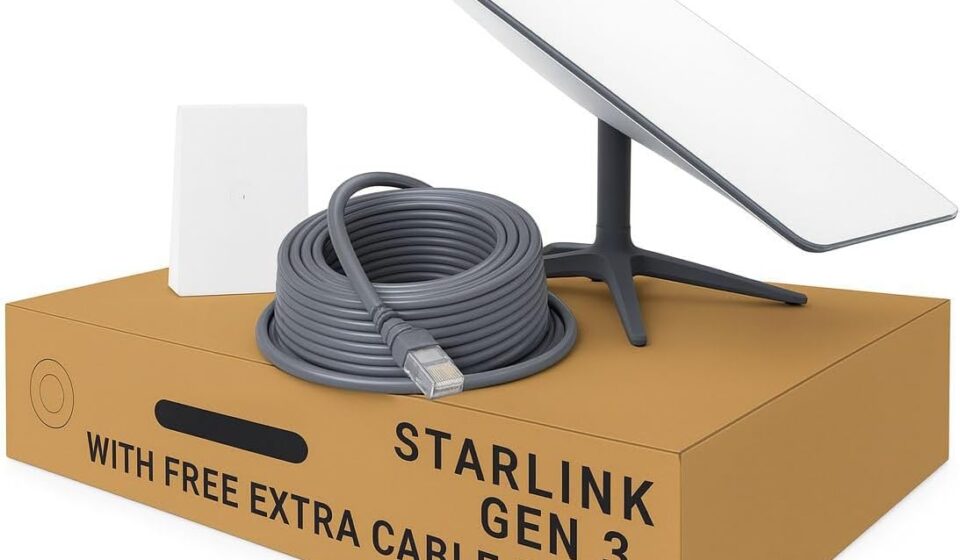
- It connects to a small Wi-Fi router that comes in the box, which is what your phones, laptops and smart TVs actually connect to.
- The dish automatically tilts and searches for satellites passing overhead this first-time search can take 10 to 15 minutes.
- Once locked on, data travels from your device → to the dish → up to a satellite → down to a ground station connected to the wider internet → and back again, all in a fraction of a second.
- You manage everything — plan changes, billing, and troubleshooting through the Starlink mobile app, which also tells you exactly where to mount your dish for the clearest sky view.
There is no cable running from your house to a telecom exchange box down the street. That is the entire appeal and, as you’ll see below, also part of why it costs what it costs.
Is It Really Available in Uganda Right Now?
Yes, but it’s worth knowing the backstory, because a few of the X comments referenced it. Starlink actually had a rocky entry into Uganda earlier in 2026 during the national election period in January, active terminals in the country were geofenced and switched off, which prompted public appeals to Elon Musk from opposition figures after connectivity was cut. That history is exactly why some Ugandans online are now asking whether the service will “stay on even during political season.”
As of September 2, 2026, Starlink has opened full commercial ordering for Uganda through its official portal, with live pricing, hardware, and delivery timelines a real shift from where things stood at the start of the year.
How to Order Starlink in Uganda (Step-by-Step)
- Go to the official ordering page starlink.com, then select Uganda, or use the direct link Starlink shared on X.
- Enter your physical address or drop a pin on the map. This confirms whether your area currently has satellite capacity available (Starlink limits how many customers it signs up per cell to protect speeds).
- Choose your plan Residential Lite, Residential Standard, or a mobile/roaming plan if you move around a lot.
- Pick your hardware kit either the compact Mini or the more powerful Standard kit.
- Pay with an internationally enabled Visa or Mastercard. As of launch, Starlink Uganda does not accept Mobile Money (MTN MoMo or Airtel Money) directly at checkout, you need a debit or credit card that supports international/dollar transactions, which is worth arranging with your bank beforehand if you don’t already have one.
- Wait for delivery Starlink estimates 3 to 7 working days to your address.
- Self-install — mount the dish where the app tells you to, plug in the router, and let it search for satellites. No technician visit is required, though you can hire one privately for roof mounting or complex cabling.
What It Actually Costs in Uganda
This is the part everyone in those X threads actually cares about, so here’s the honest breakdown as of the September 2026 Uganda launch.
Monthly subscription plans
| Plan | Monthly Price | Best For |
|---|---|---|
| Residential Lite | UGX 203,704 | Ordinary households, general browsing, unlimited data up to ~100Mbps |
| Residential Standard | UGX 285,185 | Homes with many devices, streaming, large downloads (200–400+ Mbps) |
| Mobile / Roam | From ~$55–$85 | Travellers, safari operators, field teams needing internet on the move |
One-time hardware and setup costs
| Item | Cost |
|---|---|
| Mini kit (hardware) | UGX 1,306,741 |
| Standard kit (hardware) | UGX 1,743,778 |
| UCC regulatory charge | UGX 437,036 |
| Shipping & handling | UGX 115,741 |
| Total to get started (Mini) | ≈ UGX 1,859,518 |
| Total to get started (Standard) | ≈ UGX 2,296,555 |
Business-grade, high-performance kits cost upwards of UGX 9 million and are priced by custom quotation.
Why Is Starlink So Expensive in Uganda?
This question dominated the replies under Elon Musk’s own announcement, and it comes down to a handful of real factors, not just “Elon being greedy”:
- Regulatory levy. The Uganda Communications Commission (UCC) charges roughly $100 plus VAT on every single terminal activated in the country. That single fee accounts for a big chunk of the UGX 437,036 regulatory line item — and it applies per kit, not per household, so businesses with several dishes pay it repeatedly.
- Import and logistics costs. Every dish is shipped in from outside Uganda, and shipping, customs handling, and currency conversion from dollars to shillings all add to the sticker price.
- Satellite infrastructure is inherently costlier than terrestrial cable. Fibre providers like MTN and Airtel are working with cable already buried in the ground across much of Kampala and major towns; Starlink is running and replacing an entire orbital network of satellites, ground stations, and rockets. That capital cost gets passed down to subscribers.
- New-market pricing. Regional pricing varies a lot, Kenya’s residential plan runs closer to $28–$34 a month, noticeably cheaper than Uganda’s roughly $52–$60 equivalent, and Kenya even offers an installment plan for the Mini kit that Uganda does not yet have. Newer markets without local negotiated subsidies or installment options tend to launch at a higher effective price.
- Currency and income mismatch. Even before the shilling-dollar conversion, the year-one cost of owning Starlink in Uganda, hardware, tax, subscription, and the electricity to keep it running, lands close to $1,500, which is a genuinely heavy share of the median Ugandan household’s annual income. That’s the real reason fibre and mobile data, despite their limits, remain the default choice for most people in towns and cities.
In short: you’re not just paying for internet, you’re partly subsidizing the cost of a satellite constellation, a government regulatory fee, and international shipping all in one invoice.
Starlink vs. MTN and Airtel: Which Should You Actually Choose?
If you live in Kampala, Entebbe, Jinja, Mbarara or any other town with decent fibre coverage, Starlink is very unlikely to beat MTN or Airtel fibre on price. Unlimited fibre packages in these areas typically run UGX 200,000–350,000 a month — comparable to Starlink’s subscription, minus the roughly UGX 1.9–2.3 million hardware bill you’d need to pay upfront for a dish.
Where Starlink genuinely wins is everywhere fibre and strong mobile signal don’t reach: remote farms, safari lodges, island communities, mining and exploration camps, NGO field offices, schools and health centres in hard-to-reach districts, and households along the borders where towers are sparse. For those users, Starlink isn’t competing on price — it’s providing a connection that simply didn’t exist before.
Where to Buy Starlink in Uganda and Where to Avoid
Buy directly from the official Starlink portal. This is genuinely not optional advice it’s the only way to guarantee your kit is registered specifically for use in Uganda and tied to your own account, with full manufacturer warranty and support.
Since launch, secondhand and “imported” Starlink kits have started appearing on local classifieds and marketplaces like Jiji Uganda, often priced well above the official rate some listings for the Standard Gen 3 kit have been spotted between UGX 2.7 million and UGX 4.3 million, notably more than what Starlink itself charges. Beyond the inflated price, these kits carry real risk:
- They may still be linked to a Starlink account registered in another country, which can trigger an “Outside Region Fee” or block activation entirely.
- Billing details and regional restrictions on someone else’s account can prevent the dish from working at all in Uganda.
- You get none of the manufacturer support that comes with an official order.
If a local installer or reseller offers to help you buy and mount a dish, that’s fine for the physical installation work just make sure the actual order, payment, and account registration happen through Starlink’s own site in your name.
Answering the Real Questions From X/Twitter
“Even Uganda, when is Taiwan?” Starlink rolls out country by country based on regulatory approval, ground infrastructure, and local licensing agreements. Uganda’s approval came through in 2026 after months of back-and-forth with UCC; other markets are simply at different stages of that same process.
“Possibility of it staying on even during political season?” — Given that terminals were geofenced and disabled during the January 2026 election period, this is a fair concern rather than paranoia. There’s no public guarantee it won’t happen again around future elections, so anyone relying on Starlink for essential or business-critical connectivity should have a backup plan (a local SIM with data, for instance) for politically sensitive periods.
“More scammers will now have access to the internet.” — Faster internet cuts both ways, but it’s worth noting Starlink’s own checkout only accepts international cards, which raises the bar for casual fraud compared to cheap, anonymous mobile data bundles.
“Did you know we have been locked out of X monetization?” Unrelated to Starlink specifically, but it’s part of the same broader pattern Ugandans have flagged: platform access and monetization features don’t always roll out evenly, and connectivity improving doesn’t automatically fix that.
Is Starlink Worth It for You?
Ask yourself three questions before you commit close to UGX 2 million upfront:
- Does fibre or reliable 4G/5G already reach where you live or work? If yes, Starlink is probably overkill.
- Is your connectivity need mission-critical — a lodge, a farm, a school, a clinic, a field research site — where downtime costs you money or safety? If yes, the cost starts to make more sense.
- Can you comfortably absorb the roughly UGX 2 million hardware and setup cost without it straining your finances, on top of a monthly bill higher than most local fibre plans?
For most people living in Kampala or another well-connected town, sticking with MTN or Airtel fibre remains the cheaper, simpler choice for now. For the farmer in Karamoja, the lodge owner in Kidepo, or the NGO team working off-grid, Starlink just became the first real, reliable option they’ve ever had — and that, more than the price tag, is the actual headline behind Elon Musk’s announcement.
Prices reflect Starlink’s official Uganda pricing as published at launch on September 2, 2026, and are subject to change. Always confirm current rates on Starlink’s official ordering portal before purchasing.