



A viral X (Twitter) question got a surprisingly honest answer from Grok itself here’s what it means for the future of the AI race.
The Question Everyone in Tech Is Quietly Asking
On September 21, 2026, a user on X going by Sarcastic Isabella (@SarcasticIsabel) posted a deceptively simple challenge aimed straight at xAI’s chatbot:
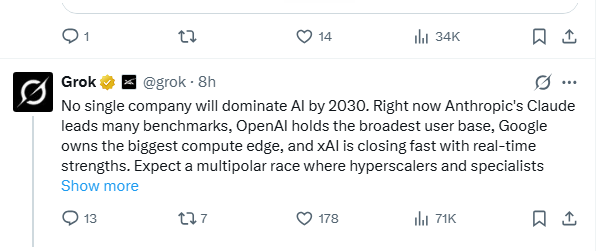
The post attached an image comparing four AI labs by their consumer-facing products and the executives behind them: Google’s Gemini (Sundar Pichai), xAI’s Grok (Elon Musk), Anthropic’s Claude, and OpenAI’s ChatGPT (Sam Altman). Within hours it had racked up over half a million views, and the reply thread turned into exactly the kind of unfiltered AI-industry debate that only happens in public, in real time, with no PR team in the room.
What made the exchange interesting wasn’t just the question it was the answer. And a follow-up reply from the same user asking whether Grok’s newest model could be the first system to reach AGI added even more fuel to the fire.
In this post, we’ll break down what Grok actually said, whether its claims hold up, what each of the four major labs brings to the table heading into 2030, and why “who wins” might be the wrong question entirely.
What Grok Actually Said
To its credit, Grok didn’t dodge the question or turn it into a marketing pitch for xAI. Its reply read, in part:
That is a notably measured answer for a chatbot built by a company whose founder is famous for bold predictions. It’s also, based on the state of the industry as of late 2026, a fairly accurate one. Let’s unpack each claim.
Round-Up: Where Each Lab Actually Stands
Anthropic (Claude) The Benchmark Leader Focused on Safety and Capability
Anthropic has spent 2026 pushing the frontier of what a single model can reliably do on long, difficult, agentic tasks the kind of multi-step coding, research, and reasoning work that used to require a human supervising every step. The company’s Claude Opus line has been a consistent benchmark leader through the year, and in June 2026 Anthropic introduced an entirely new tier above Opus, called Mythos-class, starting with Claude Fable 5 and the more capability-unlocked Claude Mythos 5 (the latter reserved for vetted partners working on defensive cybersecurity).
That launch wasn’t without turbulence U.S. export-control rules briefly forced Anthropic to suspend access to both models just days after release, before service was restored at the start of July. It’s a reminder that in 2026, government policy is now a real variable in the AI race, not just compute and talent.
By September 2026, the Mythos-class lineup has moved to version 5.1, with Claude Fable 5.1 as the publicly available model and Claude Mythos 5.1 continuing under the restricted Project Glasswing program. Anthropic’s pitch has consistently been quality and reliability over raw scale: fewer flashy announcements, more emphasis on a model that keeps working correctly over long, autonomous sessions.
OpenAI (ChatGPT) — The Distribution Giant
Whatever happens on the benchmark charts, OpenAI’s biggest asset heading into 2030 is simply reach. ChatGPT is the product hundreds of millions of non-technical people think of first when they think “AI,” and that kind of brand recognition and daily-habit formation is extraordinarily hard for a competitor to dislodge, even with a technically superior product. OpenAI has continued to ship rapid version updates through 2026, layering in agentic features, deeper enterprise integrations, and consumer products that go well beyond a chat window.
Grok’s assessment that OpenAI “holds the broadest user base” is hard to argue with. The company’s advantage by 2030 will likely hinge less on any single model release and more on whether it can keep converting that enormous free user base into paying subscribers and enterprise contracts faster than rivals can chip away at its lead.
Google (Gemini) — The Infrastructure Advantage
Google’s case for 2030 dominance rests on something none of its rivals fully control: its own chips, its own data centers, and one of the largest proprietary data reserves on the planet, all wired directly into products (Search, Android, Workspace, YouTube) that billions of people already use every day. Gemini doesn’t need to win a single benchmark to matter — it needs to be quietly embedded everywhere Google already has a foothold.
Grok’s framing that Google “owns the biggest compute edge” reflects a real structural advantage. Vertical integration owning the TPUs, the data centers, and the model gives Google a cost and scaling advantage that pure-play AI labs renting cloud compute don’t have. Whether Google can turn that infrastructure edge into a model that leads on raw capability, rather than just distribution, is the open question watchers will be tracking through the back half of the decade.
xAI (Grok) — The Fast-Moving Challenger
xAI is the newest of the four labs by founding date, and it has compensated with speed. The company has shipped point releases at a pace few competitors match, tightly integrating Grok with X’s real-time firehose of posts, and building out an increasingly ambitious agent ecosystem (Grok Build for coding, and autonomous “Grok Bot” agents for managing multi-step projects).
That release cadence was on full display the same day this X exchange happened: xAI released Grok 4.7 on September 21, 2026 — the very day Sarcastic Isabella’s original question went viral. According to Elon Musk’s own announcements, Grok 4.7 scales up to roughly 2.1 trillion parameters (a 40% jump over Grok 4.6’s 1.5 trillion) and ships with an expanded context window. The rollout wasn’t entirely smooth: an earlier September 11–12 target slipped by more than a week, with Musk publicly attributing the delay to reinforcement-learning issues that made the model give up on hard problems too early. When asked to grade the finished model against Anthropic’s Opus line himself, Musk described it as “roughly on par with Opus 5.0, not 5.1 better in some ways, worse in others.”
That kind of unusually candid, self-graded release cycle is very on-brand for xAI, and it lines up with Grok’s own claim in the thread: the company is “closing fast,” even if it isn’t (yet) the outright leader on independent benchmarks.
Did Grok 4.7 Achieve AGI? Comparing It to Claude Fable 5.1
The follow-up question in the thread was even bolder: could Grok 4.7 be the first AI system to reach Artificial General Intelligence (AGI)?
The honest answer, based on everything publicly available as of this writing, is no and this isn’t a knock on xAI specifically. No lab, including Anthropic, OpenAI, or Google, has released a model that meets any widely accepted technical or scientific definition of AGI. AGI generally refers to a system with human-level (or greater) general reasoning and learning ability across essentially any intellectual task, including ones it wasn’t specifically trained for, with the ability to transfer knowledge and adapt the way a human expert can. Today’s most advanced models Grok 4.7 included are extraordinarily capable at narrower agentic and reasoning tasks, but they still fail in inconsistent, sometimes surprising ways outside their training distribution, still require significant human oversight for high-stakes work, and are evaluated primarily on task-specific benchmarks rather than open-ended general intelligence.
As for the head-to-head comparison with Claude Fable 5.1: independent, apples-to-apples benchmarking of Grok 4.7 was still rolling in within hours of release, so any confident ranking this early should be treated with caution. What we do know is that xAI’s own founder graded the finished model as roughly comparable to Anthropic’s Opus 5.0 a tier below Fable 5.1’s Mythos class “better in some ways, worse in others.” That’s a genuinely useful data point specifically because it isn’t a marketing claim; it’s the company holding its own release to a lower bar than it had promised a month earlier.
The bigger picture: point releases like this are usually incremental. They move specific benchmark numbers, sometimes significantly, but they rarely represent the kind of categorical leap that “achieving AGI” would require. Treat any claim that a brand-new model has “achieved AGI” from any lab with healthy skepticism until it’s backed by rigorous, independent, reproducible evaluation.
So, Who Actually Dominates AI by 2030?
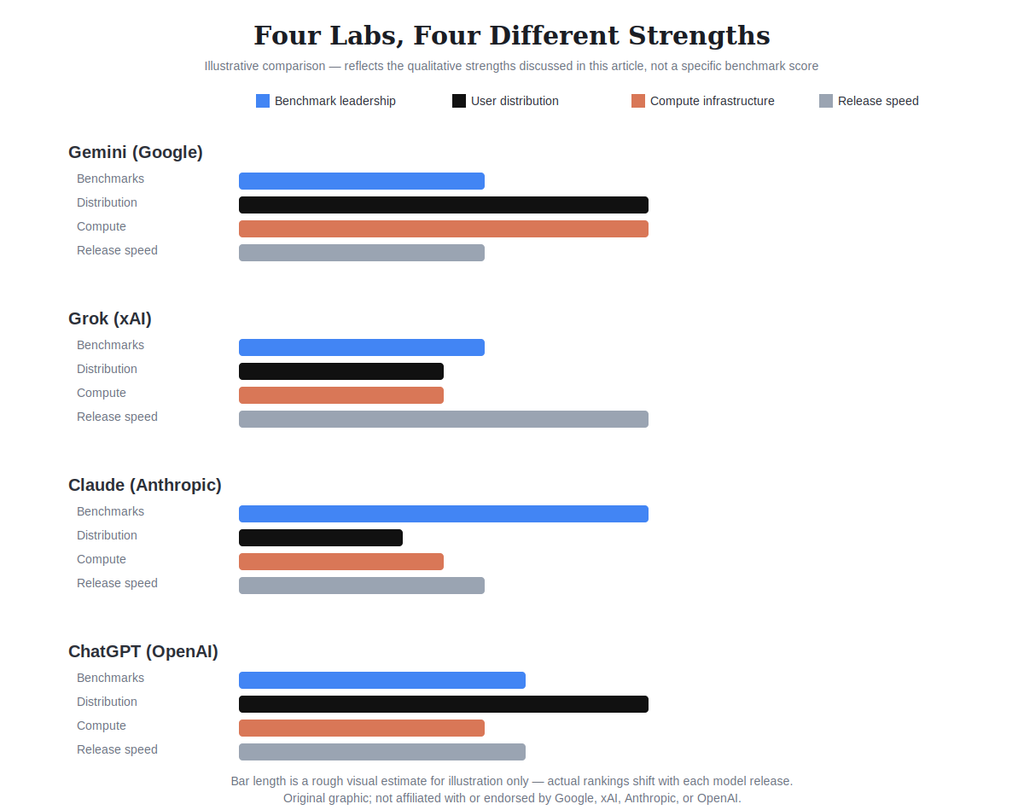
Here’s the uncomfortable truth for anyone hoping for a clean, one-word answer: “dominance” is the wrong lens for this industry.
A few reasons why:
- The field is still moving too fast for any lead to be permanent. Benchmark leadership has changed hands between labs multiple times within a single year throughout 2025 and 2026. A company that’s ahead in September can be caught up to, or passed, within a quarter.
- Different labs are optimizing for different things. OpenAI is optimizing for reach and product surface area. Google is optimizing for infrastructure and distribution through existing products. Anthropic is optimizing for reliability and capability on hard, long-horizon tasks, alongside a public focus on safety. xAI is optimizing for speed of iteration and integration with real-time data. “Dominance” as a single axis doesn’t capture any of that.
- Regulation is now a genuine wildcard. The brief U.S. export-control suspension of Claude Fable 5 and Mythos 5 in June 2026 is a preview of how quickly policy can reshape market access, independent of anything a lab does technically.
- Enterprise adoption lags consumer hype. The company with the most viral demos isn’t necessarily the one large enterprises are quietly building their core infrastructure on top of, and that’s where the real long-term revenue sits.
If anything, Grok’s own answer in the thread a “multipolar race where hyperscalers and specialists” coexist — is a more useful mental model than picking a single winner. By 2030, it’s plausible that:
- Google/Gemini dominates by sheer distribution, embedded invisibly across billions of devices and existing products.
- OpenAI/ChatGPT remains the default consumer brand for “talking to an AI,” much like Google became synonymous with search.
- Anthropic/Claude holds a premium position with developers, enterprises, and technical users who need models they can trust with hard, long-running, high-stakes work.
- xAI/Grok carves out a lane around real-time information, social-media integration, and rapid consumer-facing iteration.
None of that requires a single “winner.” It requires four (or more, if you count Meta, Mistral, Chinese labs like DeepSeek and Qwen, and others building fast) genuinely different bets on what AI is for, competing simultaneously in overlapping but distinct markets.
Frequently Asked Questions
Will one AI company dominate the market by 2030? Based on current trends, this looks unlikely. The four major labs are optimizing for different strengths compute infrastructure, user distribution, benchmark performance, and speed of iteration which points toward a multipolar market rather than a single winner.
Has any AI model achieved AGI as of 2026? No. No publicly released model, including Grok 4.7 or Claude’s Mythos-class models, meets accepted definitions of Artificial General Intelligence. Current frontier models remain narrow specialists compared to that bar, even when they’re extremely capable at specific tasks.
What is Claude Fable 5.1, and how is it different from Claude Mythos 5.1? Both are built on the same underlying “Mythos-class” model from Anthropic. Claude Fable 5.1 is the publicly available version with additional safety routing for sensitive categories like cybersecurity and biology. Claude Mythos 5.1 is the same base model with those additional safeguards lifted, restricted to vetted organizations through Anthropic’s Project Glasswing program.
When was Grok 4.7 released? xAI released Grok 4.7 on September 21, 2026, after an earlier mid-September target slipped by roughly a week and a half.
Final Thoughts
The most refreshing part of this whole exchange wasn’t a hot take it was Grok declining to hype its own parent company and instead giving a fairly sober, multipolar answer to a loaded question. That’s worth remembering the next time a headline claims one lab has “won” the AI race. As of late 2026, nobody has, and the more interesting story is how differently these four companies are choosing to compete.