


Imagine waking up one morning to find that the platform holding your life savings has gone dark no website, no support line, no explanation. That’s exactly what happened to tens of thousands of people on February 24, 2014, when Mt. Gox, the exchange that once handled 70% of all Bitcoin transactions worldwide, simply disappeared.
This isn’t just a story about stolen coins. It’s a story about how an entire industry learned the hard way what happens when trust, technology, and money collide without proper safeguards.
From Trading Cards to Trillions: The Strange Origins of Mt. Gox
Here’s a detail most people don’t know: Mt. Gox wasn’t even built for Bitcoin. The name stands for “Magic: The Gathering Online Exchange” it started as a trading site for a card game before being repurposed into a cryptocurrency exchange in 2010. By the time Mark Karpelès, a French programmer, took over as CEO, the platform had accidentally become the beating heart of the global Bitcoin market.
At its peak, Mt. Gox wasn’t just popular it was essentially the market. If you wanted to buy or sell Bitcoin anywhere in the world, there was a good chance you were routing through Tokyo without even realizing it. That level of concentration is one of the most overlooked lessons of this story: an entire global asset class depended on one under-resourced company with almost no regulatory oversight.
The Slow Collapse Nobody Wanted to Believe
The end didn’t come suddenly. In early February 2014, Mt. Gox quietly paused Bitcoin withdrawals, blaming vague “technical issues.” For over two weeks, users were met with silence while rumors spread that the exchange was in serious trouble.
Then, on February 24, the website went dark without warning. Even the company’s social media accounts were wiped clean. A few days later, Karpelès appeared at a press conference in Tokyo, bowed in apology, and admitted the company had lost track of 850,000 Bitcoins 750,000 belonging to customers and 100,000 belonging to the company itself. At the time, that was worth roughly $450–480 million. In today’s prices, it would be worth well over $50 billion.
Karpelès initially pointed to a technical flaw exploited by hackers. But investigations that followed painted a messier picture: years of poor bookkeeping, no real security audits, and a company that had likely been leaking Bitcoin slowly since 2011 long before anyone noticed.
How People Actually Reacted (And What They Said)

This is the part most retellings skip the human side.
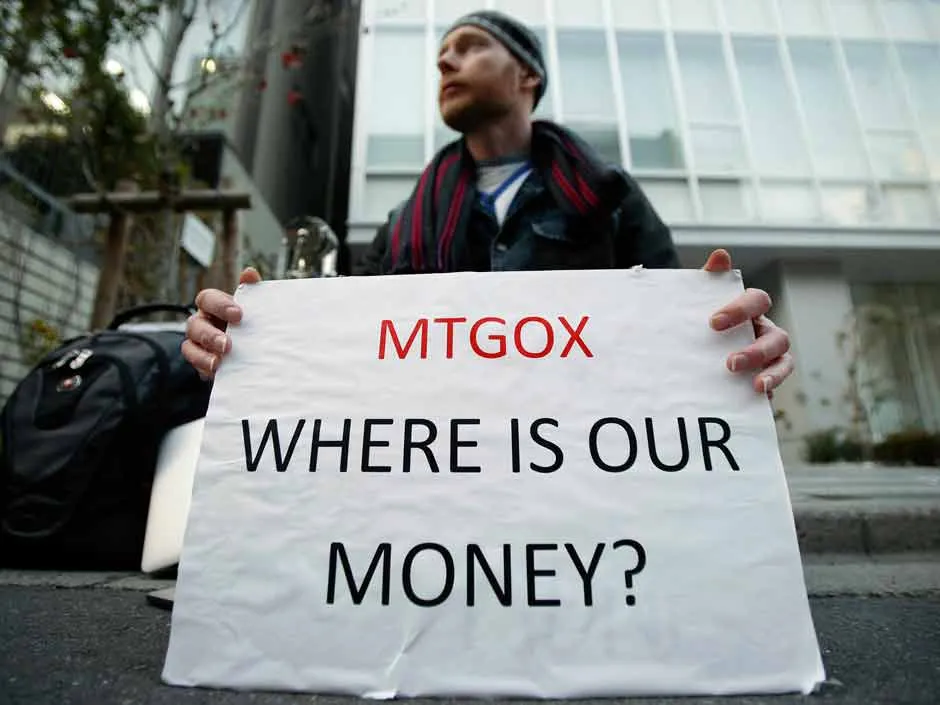
Disbelief turned to protest. One of the most memorable moments came from Kolin Burges, a software developer and Mt. Gox user who flew from London to Tokyo and stood outside the company’s headquarters holding a handwritten protest sign, demanding answers in person. His one-man demonstration became one of the defining images of the collapse, broadcast by news outlets worldwide.
The crypto community turned on itself. Rather than uniting in sympathy, six other major Bitcoin exchanges issued a joint statement distancing themselves from Mt. Gox, effectively saying “this is not who we are.” It was an early example of an industry trying to protect its own reputation while one of its founding members burned.
Some users refused to give up hope and were vindicated. A community of victims, who came to call themselves “Gox creditors,” organized online to track the bankruptcy proceedings for years. Many assumed their coins were gone forever. Then, in 2015, over a year after the collapse, Karpelès announced that roughly 200,000 of the missing Bitcoins had been “found” in an old digital wallet. Instead of celebration, the reaction was largely suspicion many creditors publicly questioned how a company could simply “forget” about a fortune, and accused Karpelès of manipulating the narrative.
A strange kind of silver lining emerged. Because the bankruptcy process dragged on for a full decade, creditors were legally locked out of selling their claims or coins essentially forced into holding Bitcoin whether they wanted to or not. Some described this “forced HODLing” as maddening at the time. But because Bitcoin’s price rose dramatically over the following ten years, many creditors ended up in a strange position: the very delay that outraged them for years left them with assets worth far more than what was originally stolen.
The Repayment Saga: Justice, Just Really, Really Late

For most of the 2010s, Mt. Gox creditors had little reason for optimism. Legal proceedings in Japan moved slowly, and many assumed they’d either get nothing or a tiny fraction of their losses.
That changed when a Tokyo court approved a formal rehabilitation plan, and in 2024 a full decade after the collapse Mt. Gox’s trustee began actually distributing Bitcoin and Bitcoin Cash back to roughly 127,000 verified creditors. The repayment involved moving well over 140,000 Bitcoin, an amount worth billions of dollars, out of long-dormant cold storage wallets.
The irony is hard to overstate: people who lost a few hundred dollars’ worth of Bitcoin in 2014 potentially received life-changing sums a decade later, purely because they had no choice but to wait.
What Actually Went Wrong (The Educational Part)
Most explainers stop at “it got hacked.” That’s incomplete. Here’s what really failed:
- No separation of hot and cold wallets at scale. Mt. Gox kept far too much Bitcoin in wallets connected to the internet, making it a persistent target rather than a one-time break-in.
- No independent audits. There was no external verification of how much Bitcoin the company actually held versus what it claimed to hold a basic safeguard that’s now considered essential for any exchange.
- Founder-led, single point of failure management. Karpelès reportedly managed core technical systems largely on his own, meaning there was no internal check when something went wrong.
- A slow leak, not a single heist. Evidence gathered after the collapse suggested Bitcoin had been disappearing from Mt. Gox’s wallets gradually since as early as 2011 meaning the exchange operated for years while effectively insolvent, without anyone catching it.
- Regulatory vacuum. In 2014, cryptocurrency exchanges operated in a near-total legal gray area. There were no capital requirements, no mandated insurance, and no consumer protection laws designed for digital assets which is precisely why nobody caught the problem sooner.
Why This Still Matters in 2026
Every time you hear about a modern exchange emphasizing “proof of reserves,” cold storage insurance, or third-party audits, you’re looking at a direct legacy of Mt. Gox. The collapse is the reason regulators in Japan, the US, and the EU began treating crypto exchanges less like tech startups and more like financial institutions that need oversight.
It’s also a case study far beyond crypto. The core lesson applies to any platform holding other people’s money or data: transparency isn’t optional, concentration of trust in one company is dangerous, and “we got hacked” is often only half the story.
The Bottom Line
Mt. Gox wasn’t just a hack it was a slow-motion failure of oversight, honesty, and basic financial hygiene, dressed up as a cybersecurity incident. The people who lived through it didn’t just lose money; some spent a decade in limbo, organizing, protesting, and waiting for a resolution that finally came in 2024. Whether you see the ending as poetic justice or a cruel decade-long joke depends on who you ask but either way, it remains one of the most important cautionary tales in tech history.
Curious about other tech scandals that reshaped entire industries? Explore more deep dives on SlecxTec.